





Moving Company vs. PODS: Which Is Cheaper in 2026?
The True Cost of Hiring a Moving Company Goes Beyond the Hourly Rate

Most people shop for movers by asking one question: what's the hourly rate? Understandable. But that's also how people end up surprised on moving day when the final bill looks nothing like the estimate. The hourly rate is just the starting point.
Here's what actually drives your total cost when you hire a moving company in Austin.
Labor is the biggest line item. Most local moves are billed by the hour, and that clock starts when the truck leaves the warehouse — not when movers show up at your door. The industry calls this "portal-to-portal" billing, and it's standard practice [SOURCE TBD: moving industry billing practices]. On a busy Saturday in South Austin, that drive time alone can add 30–45 minutes to your bill before a single box is touched.
The number of movers matters just as much as the rate. A two-person crew costs less per hour than a three-person crew — but a two-person crew on a three-bedroom house can take four hours longer. We see this constantly. Customers choose the smaller crew to save money and end up paying more because the job runs long. Do the math before you book.
Truck size is another variable people underestimate. If your belongings don't fit in one load, you're paying for a second trip — more drive time, more labor hours, and sometimes an extra fuel surcharge. According to the American Moving and Storage Association, the average local move takes 4–7 hours when factoring in load time, drive time, and unload [SOURCE TBD: AMSA move time data]. A second trip can push that well past a full day.
Stairs, long carries, and elevators all add fees. Most moving companies charge a stair fee per flight above the first floor [SOURCE TBD: moving company fee structures]. Moving out of a walk-up in Hyde Park? Into a high-rise with a slow elevator? Those fees stack up fast. Some companies also charge a "long carry" fee if the truck can't park within a certain distance of your front door — usually 75 feet [SOURCE TBD: moving company fee structures].
Fieldwork note: Last spring we helped coordinate a move out of a 1960s fourplex near UT Austin. The stair fee alone added nearly an hour of equivalent labor cost, and the street parking situation meant a long carry charge on top of that. The customer hadn't budgeted for either. If you're navigating a similarly tricky property, it's worth talking through the details with a local Austin moving professional before you lock in any quote.

Packing materials are often sold à la carte. If you ask the movers to pack your kitchen, they'll charge for boxes, paper, and tape — usually at a markup above retail [SOURCE TBD: moving company packing material pricing]. Some people are fine with that. Others prefer to pack themselves and just pay for the muscle. Know which category you're in before the truck shows up.
Timing affects price more than most people realize. Moving during peak season — May through August in Austin — means higher demand and less flexibility in scheduling [SOURCE TBD: moving industry seasonal data]. End-of-month dates are the busiest. Mid-week moves in January or February? You'll often get faster service and more crew attention, because they're not running back-to-back jobs all day.
Valuation coverage — what most people call "insurance" — is worth understanding too. Basic released value protection is included by law, but it only covers 60 cents per pound per item [SOURCE TBD: FMCSA valuation rules]. That means a 50-pound TV is covered for $30. Full value protection costs more and is usually offered as an add-on. Not glamorous to think about, but it changes your real exposure if something gets damaged.
The hourly rate tells you almost nothing on its own. Crew size, truck capacity, building access, timing, and add-ons — that's the full picture. That's what you actually pay.
PODS Pricing Has More Variables Than Most People Expect
Most people get a PODS quote online and think that's the number. It's not. The base quote covers only the container rental. What you actually pay depends on a handful of factors that don't show up until later — and some of them can catch you off guard.
The biggest variable is how long you keep the container. PODS charges by the month, not by the move. If you're buying a house in Austin and your closing date slips by three weeks — which happens more than you'd think in this market — you're paying for another full rental period. That extra time adds up fast. [SOURCE TBD: PODS pricing structure, consumer finance publications]
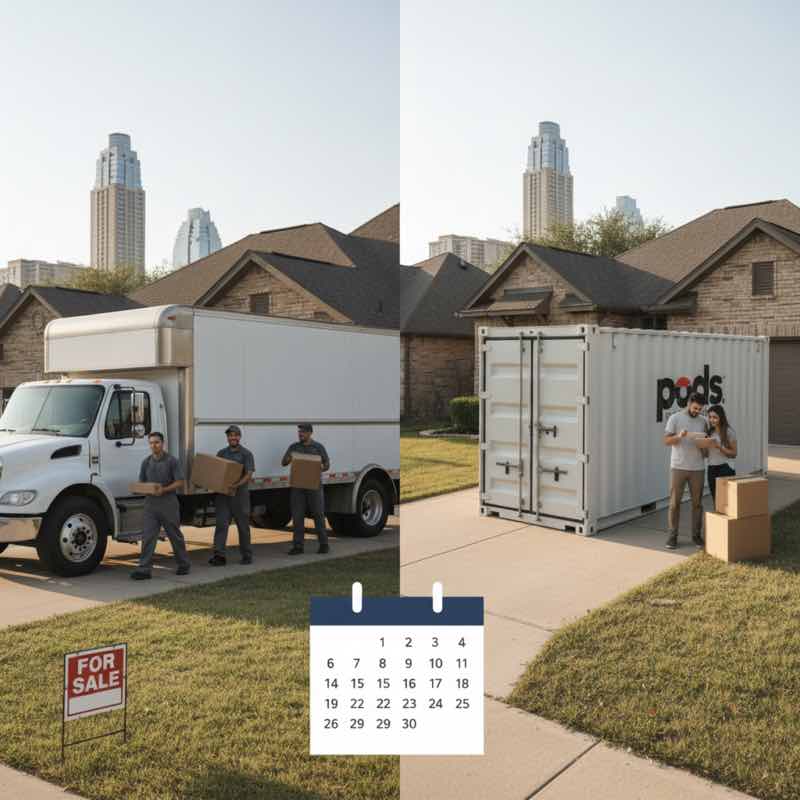
Distance is the second big one. A local move inside Austin is priced very differently than a move from Austin to Dallas or Austin to Denver. Long-distance PODS moves use a different pricing model entirely — the container gets loaded onto a truck and driven by PODS, which means you're paying for fuel, driver time, and logistics, not just storage. According to data compiled by moving industry researchers, long-distance portable container moves can cost considerably more per mile than local ones, especially for moves over 500 miles. [SOURCE TBD: moving industry cost data, PODS long-distance pricing studies]
Here's something most guides skip right past: delivery and pickup fees are separate line items. You pay once when they drop the container at your door, and again when they come to pick it up. If the container needs to go to a storage facility in between — say, you're moving out of your apartment before your new home is ready — that's a third trip charge. We see this constantly with Austin clients caught between lease end dates and home closing dates.
Ground conditions matter too. If your driveway isn't level, or if the container has to be placed on a street, PODS may require a permit from the City of Austin. Permit fees vary by neighborhood and aren't included in your quote. [SOURCE TBD: City of Austin temporary structure/right-of-way permit requirements] Some neighborhoods in Central Austin have strict rules about how long a container can sit on the street. Historic district or HOA community? Check those rules before you book anything.
Container size is another lever. PODS offers different container sizes, and choosing the wrong one means either renting a second unit or cramming things in badly. We had a client last spring moving out of a four-bedroom house in South Austin who booked based on square footage alone — didn't account for high ceilings and oversized furniture. Ended up needing a second container delivered mid-pack. That's a second delivery fee on top of everything else.
One more thing people miss: insurance. PODS offers their own content protection plan, but it doesn't work the same way as full-value protection from a licensed moving company. [SOURCE TBD: PODS content protection plan terms, moving insurance comparison sources] High-value items — artwork, antiques, electronics — may require a separate policy. That cost doesn't appear in any online quote tool. Reading through verified customer reviews of PODS moving experiences can give you a clearer sense of how these coverage gaps play out in real moves.
The honest takeaway is that PODS pricing is modular. Every piece of your move adds or removes cost. That's not necessarily a bad thing — it can actually work in your favor if you plan carefully. But go in expecting one flat number, and you'll be caught off guard. Before you commit to a container option, map out every phase of your move: drop-off, pack time, storage time, delivery, and pickup. Price each step. That's the only way to compare it accurately against hiring a full-service moving company.
Side-by-Side Cost Comparison: Local Austin Moves vs. Long-Distance Relocations
The question of hiring a moving company vs. using PODS — which is cheaper in 2026 — doesn't have one clean answer. It depends almost entirely on how far you're going and how much stuff you have. Here's how I'd break it down for a neighbor standing in their driveway.
For local moves inside Austin — South Congress to Round Rock, or Mueller to Pflugerville — full-service movers tend to run faster. They show up, load, drive, and unload in a single day. You pay for hours worked. A portable container, by contrast, gets delivered to your door, sits there for days or weeks while you load it yourself, then gets picked up and dropped at the new address. That delivery-and-pickup fee structure adds up quickly on short distances. [SOURCE TBD: moving industry cost survey]
We see this constantly on local jobs. A customer in Buda called us last spring after pricing out a container for a two-bedroom move to Cedar Park. By the time she added the delivery fee, the monthly rental period, and the return pickup, the total was within $200 of just hiring a crew for four hours. The container made zero sense for a 22-mile move.
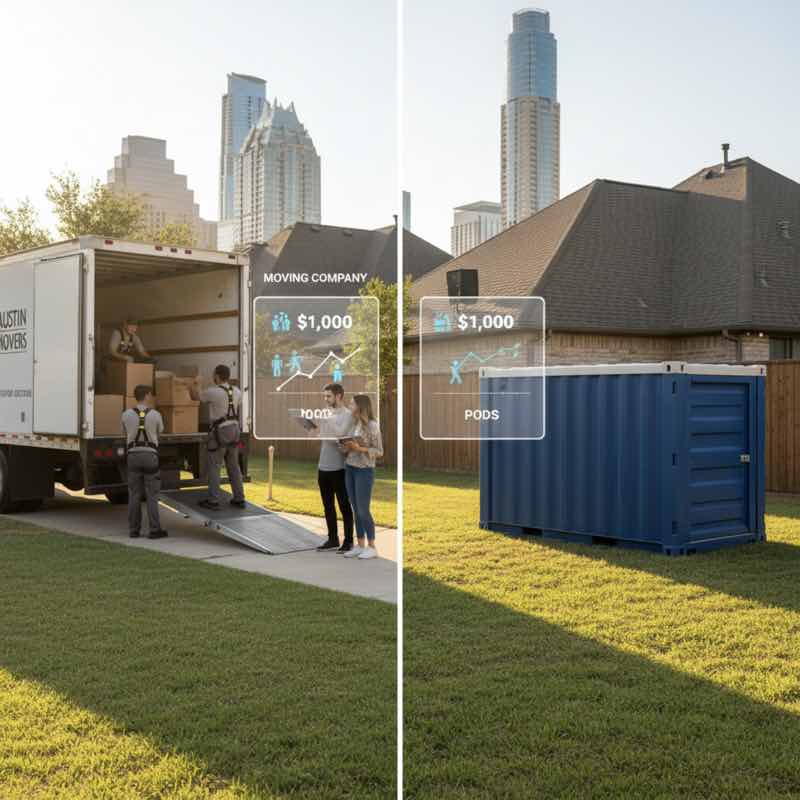
Long-distance moves flip that math entirely. If you're leaving Austin for Dallas, Denver, or anywhere more than 500 miles out, a container can save you real money — especially if your schedule is flexible. Full-service movers charge by weight and distance on interstate moves, and that can get expensive fast. A container lets you control the packing timeline and sometimes skip the weight-based pricing model altogether. [SOURCE TBD: American Moving and Storage Association data]
But here's what most guides get wrong: they compare sticker prices without factoring in your labor. A container is only "cheaper" if your time has no value. Loading one correctly — so nothing shifts and breaks — takes most people two to three days. That's time off work, a sore back, and usually a few damaged items anyway. Full-service movers include labor in the quote. That labor has real dollar value even when it doesn't show on a line item.
Austin's geography adds another wrinkle. Older neighborhoods — Hyde Park, Clarksville, East 6th — come with narrow streets, low-hanging oak trees, and no real curb space. Dropping a container on a street like that sometimes isn't even possible without a permit from the City of Austin Transportation Department. [SOURCE TBD: City of Austin permit requirements] Full-service movers work around that with smaller trucks and more hands. We've had to redirect jobs mid-morning because a container couldn't legally sit where the customer expected it to.
For apartment moves — which make up a huge share of Austin relocations given how many people rent here — containers almost never work. Most apartment complexes won't allow a container in their lot. Full-service movers are the only realistic option for high-rise or multi-story buildings. [SOURCE TBD: apartment complex policy surveys] If you're in that situation and want a clearer picture of what full-service moving actually costs for your specific building, our Hiring a Moving Company vs. Using PODS: Which Is Cheaper in 2026? page walks through real Austin scenarios in detail.
Here's a quick way to think about it:
- Local move under 100 miles: Full-service movers are usually competitive in total cost once you count your own labor
- Long-distance move over 500 miles with flexible timing: A container can reduce cost if you pack yourself and don't mind waiting
- Apartment or restricted-access property: Full-service movers are often your only real option
- Large household with lots of heavy furniture: Weight-based container pricing can spike; get a firm quote before committing [SOURCE TBD: moving weight estimate guides]
The honest answer is that most Austin moves — especially local ones — don't favor containers on a true cost comparison. The savings look real on paper. They disappear once you account for your time, the permit situation, and the risk of a damaged couch you packed yourself at midnight.
Now that you know what to look for, let us handle it. As your Austin local mover, we've put together a page that breaks down everything you need to make the right call for your upcoming move — and we're ready to give you a straightforward quote with no surprises. Call us at (737) 381-1968 or schedule your estimate online. No pressure, just answers.
Frequently Asked Questions
Is renting a PODS container actually cheaper than hiring movers in Austin?
It depends on your move — there is no single answer that works for everyone. For short local moves inside Austin, hiring movers can actually cost less when you factor in your own labor loading the container. For longer moves or flexible timelines, PODS may save money. The real difference shows up in the details: how long you keep the container, your building's access, and how far you're going.
How does Austin's housing stock affect moving costs?
Austin has a lot of older properties — walk-up apartments near UT, 1960s fourplexes in Hyde Park, and high-rises downtown with slow elevators. These building types add real costs. Stair fees, long carry charges, and elevator wait time all show up on your final bill. Street parking near many central Austin properties also limits where a moving truck can stop. If your home has any of these features, talk through the access details with your mover before booking.
Does Austin's summer heat affect which moving option is better?
Yes — Austin summers are brutal, and that matters for both options. Peak moving season runs May through August, which means higher demand and less scheduling flexibility for movers. If you rent a PODS container during summer, you or your helpers are loading it in 100-degree heat. Either way, heat adds physical risk and slows the work down. If you can move in January or February, you will likely get better availability, more crew attention, and a smoother overall experience.
What is a common mistake people make when comparing moving company quotes in Austin?
The biggest mistake is comparing quotes based only on the hourly rate. That number tells you almost nothing on its own. What you actually pay depends on crew size, drive time, stair fees, long carry charges, and timing. A two-person crew looks cheaper until the job runs four hours longer than a three-person crew would have taken. Always ask for a full written estimate that includes portal-to-portal billing, any access fees, and packing materials before you commit.
When should you hire professional movers instead of renting a container?
Hire professional movers when you want the job done in one day and do not want to do any lifting yourself. If you have a tight move-out deadline, stairs, heavy furniture, or a building with access restrictions, movers handle all of that for you. PODS works better when you need flexible timing — like waiting on a closing date. If your schedule is fixed and your Austin property has tricky access, a full-service moving crew is usually the safer call.
What does PODS actually charge for beyond the base rental price?
The base quote only covers the container rental period. You also pay for delivery, pickup, and transportation — and those fees are separate. If your closing date slips or you need the container longer, you pay for another full rental month. Long-distance moves use a different pricing model that adds fuel and driver costs. Local Austin moves are priced differently than moves to Dallas or Denver. Always ask for a full cost breakdown before you sign anything.




Google Reviews
518 Reviews | 4.9 Avg Rating